October 19, 2026
Champion House was taking shape for Patience Champion in 1854. Her eldest child, B. F. Champion, is named near the end of the Semi-Weekly Advocate’s February 22 account of the Kate Kearney disaster.
At the beginning of its column, the Advocate placed the explosion in a run of river tragedies. It recalled boats damaged by severe weather at the St. Louis levee and steamers destroyed by fire at New Orleans. Now, the paper reported, the Kate Kearney’s boilers had exploded in St. Louis.
The Advocate cautioned that its casualty figures were incomplete. Based on what it could gather, seven people had been killed, including those who died of their wounds, and about twice that number were seriously injured. The article named an Episcopalian clergyman from St. Louis who was headed to Springfield to lecture to the Young Men’s Christian Association. It also reported that a wealthy merchant from Linn, Missouri, had been thrown into the river and was still missing.
Two Belleville women were aboard: Olive Harrison and her teacher, Miss Otis. With no early word about who had survived, Harrison’s family feared the worst. Later that evening, news came that both women had escaped uninjured.
Near the end of the column, the Advocate named B. F. Champion “of this city” and L. D. Turner “of this county,” saying the two men “made a narrow escape in two ways.” They had been passengers on the Kate Kearney the evening before its trip down from Alton. The article called the boat “miserably defective”; that is the paper’s description, not a finding established by this clipping.
The next day, Champion and Turner had just reached Wiggins’s corner on their way to the ferry when the explosion occurred. They were only a few feet from the spot where a piece of the boiler fell after striking the upper story of a building.
The column does not record what either man thought after that near miss. Champion’s name appears briefly near the end of a report otherwise filled with loss, unanswered questions, and the hazards of river travel. For the two Belleville women, the paper does record the hours of uncertainty before word came that they had survived.
That brief paragraph brings the Champion family into the daily life of Belleville in 1854. The house’s history is usually traced through construction, residents, and ownership. Here, Patience Champion’s child appears in a moment of chance: B. F. had been aboard the steamboat the evening before, then came within a few feet of the debris when it exploded.
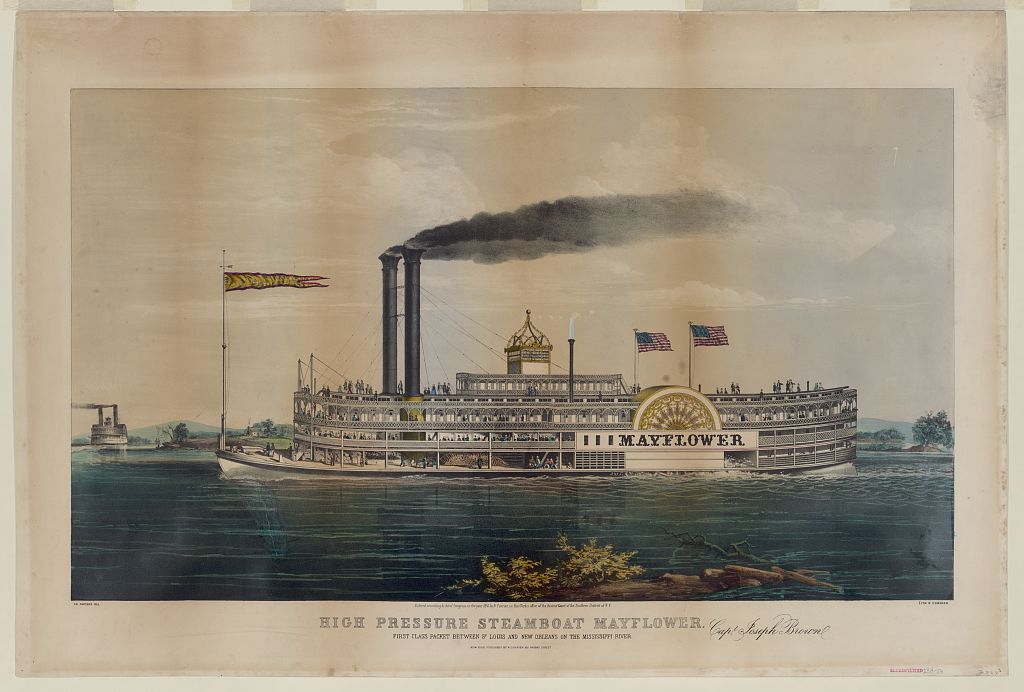
Illustration note: The Mayflower is not the Kate Kearney. It is a Mississippi packet depicted in an 1855 Currier & Ives print. The Library of Congress lists no known restrictions on publication.
View the Library of Congress print record.
Source: “The Explosion of the Kate Kearney,” The Semi-Weekly Advocate (Belleville, Illinois), February 22, 1854, page 2.